Sewer Line and Sump Line Work in Indianapolis and Central Indiana
Sewer and sump lines move water without any help from pressure, so everything about them depends on getting the fall right and keeping it.
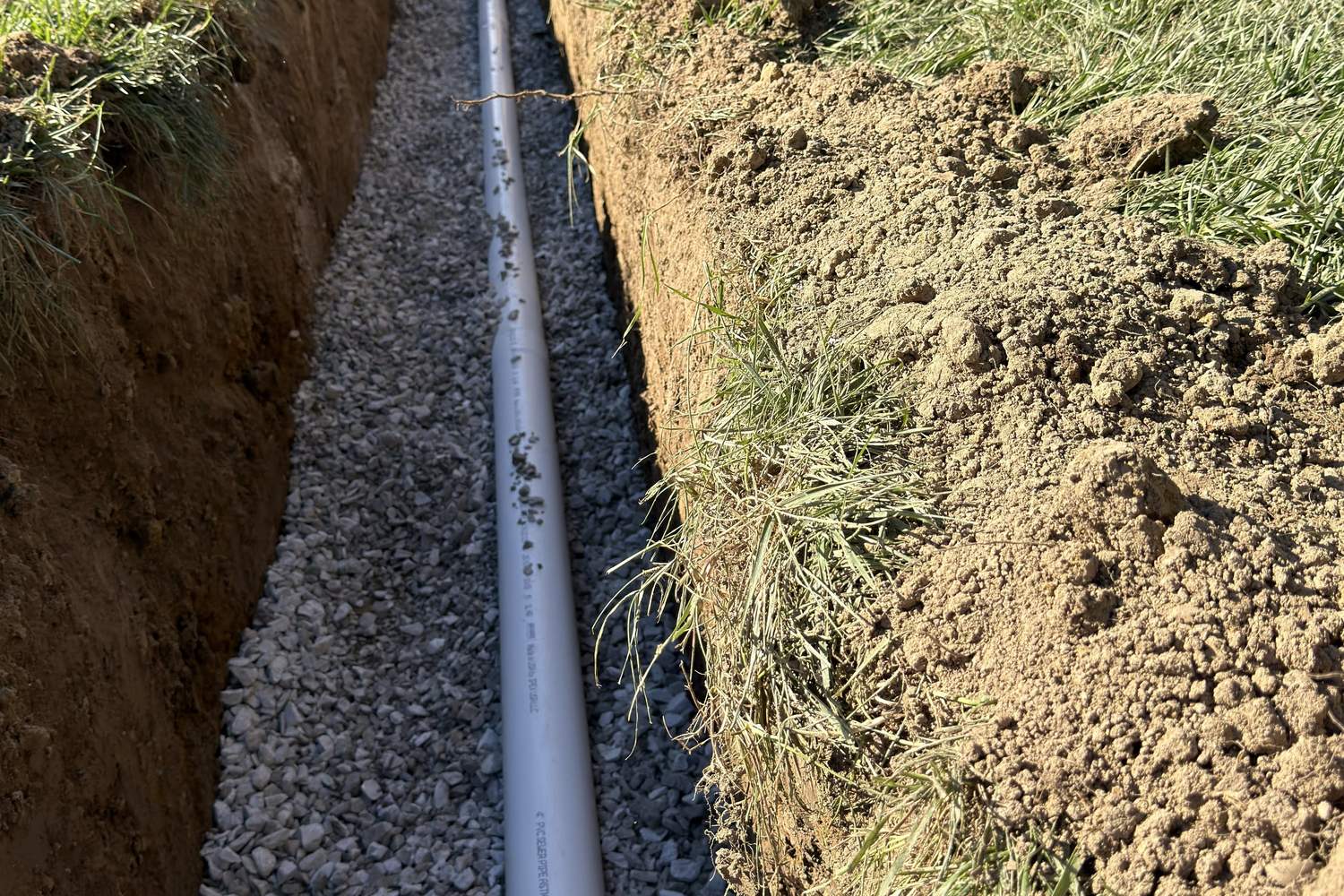
A sewer line and a sump discharge line both carry water away from a building by gravity, which means they only work while they keep their slope. We replace, repair and re-route those lines, set them at a consistent fall, and get the water out to where it belongs.
The difference between these lines and a water service is that nothing pushes. A pressurized line will move water uphill and around a dip without complaint. A gravity line will not. Give it a low spot and solids settle there, the low spot narrows, and eventually the line backs up into the building at the worst possible hour. That is why so much of this work is about elevation rather than about pipe.
The failures we get called for follow a pattern. Old clay tile joints open up and tree roots find them, because roots go where the water is. A section settles because the original backfill was never properly compacted, and the line develops a belly it cannot clear. A line gets crushed by traffic or by a later project that dug across it. Sump discharge lines add their own version: the outlet freezes shut, or the line was run to a spot that pushes the water straight back toward the foundation.
We open the ground, take out what has failed, and put the run back at a fall that holds. Where a line crosses under a driveway or a finished area, we look at whether boring the crossing is the better answer than cutting the surface. The route, the depth, the tie-in at the building and where the discharge ends up are all settled in the written estimate before the work is scheduled.
How a sewer or sump line job runs
The office takes the details
Tell us what is backing up or where the water is coming out, what the building is, and how old the line is if you know.
Scope and service area
We confirm the property is in our area and work out how much line is involved and what it connects to at each end.
On site look
We come out and read the elevations, the outlet, the building connection and what sits over the route.
Written estimate
You get the scope in writing: the run being replaced, the crossings, the tie-ins and how the ground gets put back.
Scheduling, permits and locates
We schedule the work and arrange the permits, the Indiana 811 locate with its two working day notice, and any inspection required.
The work and the close out
The crew keeps you informed while the line goes in, and the job ends with a final inspection and the invoice.
What goes wrong underground
Clay soil is patient. Central Indiana sits on heavy glacial till, water drains through it slowly, and a trench backfilled without care will keep settling for years after the machines leave. When a length of gravity line settles even slightly out of true, it holds standing water, and standing water in a sewer line is where every future blockage starts. A line that gets snaked clean every spring is usually telling you it has a shape problem, not a debris problem.
Roots are the other half of it. Older lines were built in sections with joints, and every joint is a place a root can eventually reach. Once a root is inside, it does not have to fill the pipe to cause trouble, it just has to catch things going by. Repairing the joint is a temporary answer if the whole run is the same age and built the same way, which is why the honest recommendation is often a replacement of the run rather than a patch of one spot.
What this does not cover
We handle the line from the building outward and the ground it sits in. Drain cleaning inside the house, fixture work, stacks and anything on the inside of the foundation wall belong to a plumber. We are not a septic system designer either, so if what you need is a new septic field engineered and permitted as a system, that is a septic contractor's lane. If you are not sure which side of that wall your problem is on, describe it to the office and we will tell you straight.
Sewer and Sump Line Questions
My drains back up every few months. Is that a line problem or a plumbing problem?
A recurring backup that comes back on a schedule usually means the line outside has a shape problem rather than a one time clog. A cleaning clears the symptom and the low spot or the root intrusion that caused it is still there. A plumber can tell you where the blockage sits. Once it is outside the building wall and in the ground, it is our work.
Where is the sump discharge line supposed to end?
Far enough from the building that the water does not simply run back down against the foundation and into the pit again. Where exactly that is depends on your grade, your lot and what your community allows, which is one of the things we read on site. Permits and any inspection required for the discharge are part of what the office arranges before the work starts.
Can you replace a line under a driveway without tearing it up?
Often, yes. Directional boring puts a new line under a driveway, a sidewalk or a road without cutting a trench across it, and it is one of the services we run. Whether it fits here depends on depth and on the fall a gravity line needs, since a bore has to hold slope for a sewer run. We tell you which method the site actually supports before you sign anything.
Do you do this work for contractors and builders?
Yes. Builders, general contractors, businesses and municipalities are a large part of who we work for, alongside homeowners. On new construction we set the sewer and sump runs to the grades the build needs. On existing property we replace what has failed and put the ground back.
Sewer and Sump Line Work, in Their Words
Left on our Google profile by the people we did the work for.
“We hired Wharff Excavating to repair our sewer line, and they did an excellent job. The crew worked hard, treated our property with respect, and completed the repair efficiently. The quality of their work exceeded our expectations, and everything was finished on time. I would recommend Wharff Excavating to anyone needing sewer repair.”
“Wharff Excavating did a great job on fixing our sewer line. They were fast, professional, and the price was about half the cost of what other companies quoted. Everything was handled quickly and correctly with no hassle. Highly recommend them if you want quality work at a fair price!”
Request a Sewer and Sump Line Estimate
Tell us where it is and what it is doing. If you have photographs of the problem, send those too.
We look at it on site before we quote it, and the estimate comes to you in writing.