Culvert Installation and Replacement in Central Indiana
A culvert is the pipe that keeps a ditch running underneath your driveway, and it only does its job when the depth and the fall are right.
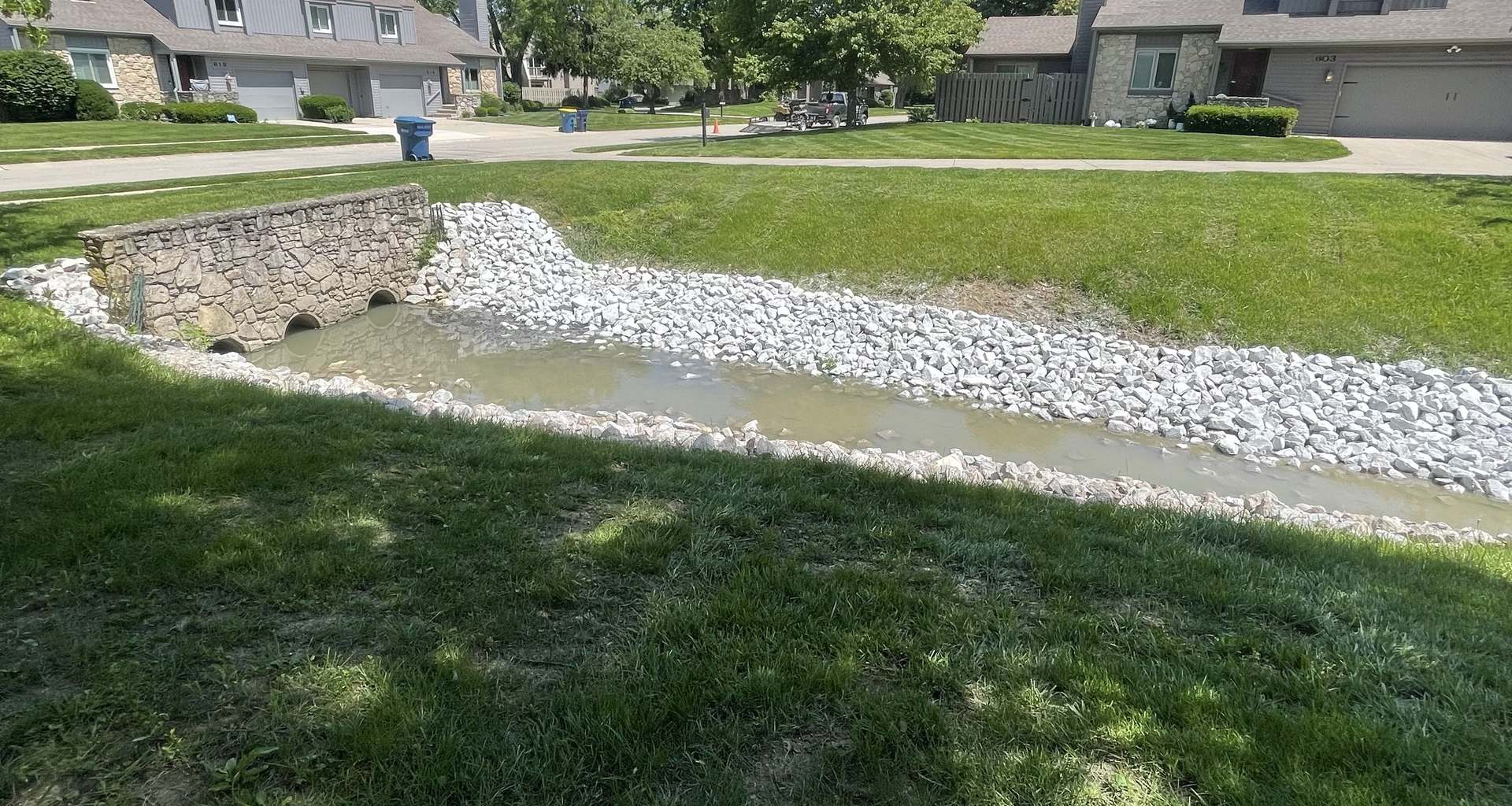
A culvert carries ditch water under a driveway or a field entrance instead of letting it back up against it. It has to be sized for the water actually coming at it, bedded on firm material at a slope that keeps it flowing, and backfilled and compacted well enough that traffic overhead never reaches it.
Nobody thinks about the pipe under their driveway until the day it stops working. Then it is very hard to think about anything else. Water backs up on the upstream side and spreads across the road or the yard. The drive over the pipe develops a dip, then a hole. Sometimes the first sign is that the ditch on one side of the entrance is running and the ditch on the other side is dry, which means the water is going somewhere it was never supposed to go.
The usual causes are not mysterious. The pipe silted in and nobody cleaned it out. The pipe was undersized for the water the ditch actually carries in a hard rain. It was set too high, so it only flows once the ditch is already full. It got crushed by traffic because it was buried too shallow or the backfill around it was never compacted. Or it simply reached the end of its life, which old corrugated metal pipe eventually does from the bottom up where the water runs.
Setting one correctly is careful work in a small space. The trench gets dug to depth, the bed gets built so the pipe is supported evenly along its whole length rather than bridging between two high spots, and the fall gets set so water keeps moving through instead of dropping its silt inside. Then the ends get protected so the banks do not wash out around them, and the backfill goes in and gets compacted in lifts so the drive over the top holds its shape under load. We do this for homeowners, for builders opening a new entrance, and for municipal work along road and ditch lines.
From the first call to the finished pipe
What you tell the office
Describe what the water is doing, where the entrance is and how the ditch runs, and the office gets it written down.
Scope and jurisdiction
We confirm the location is in our area and work out what the job actually involves, including who has authority over that ditch or road frontage.
Reading the site
We come out and look at the ditch line, the elevations at both ends and what the existing pipe is doing, because sizing and fall come from the site, not from a description.
Estimate in writing
A detailed written estimate goes out covering excavation, the pipe, end treatment and restoring the surface over the top.
Permits, locates, schedule
We handle the permits and the utility locates and put the work on the schedule with whatever inspection is required.
Set, backfill, inspect
The pipe goes in and the crew keeps you informed through it, then a final inspection and the invoice close the job.
What a failed culvert does to the ditch line
A ditch is a drainage system, and a blocked culvert makes it stop being one. Water that cannot get through the pipe finds another route, and the route it picks is rarely convenient. It spreads across the road surface, which is a safety problem as well as a maintenance one. It floods the field or the yard on the upstream side. It cuts a new channel around the end of the pipe, which then undermines the driveway from the side while the pipe itself still looks fine.
The clay ground here makes this worse rather than better. Water does not soak away while it waits, so once it is standing it stays standing, and the volume just keeps building until it finds an outlet. Then when it does move, it moves fast and it takes soil with it. That is how a small blockage in a pipe turns into a washed out entrance, a scoured bank downstream and a repair that costs far more ground than clearing or replacing the pipe would have.
What sits outside a culvert job
We install and replace pipe and restore the drive surface over it. What we do not do is decide the rules. Requirements for pipe size, depth, end treatment and right of way along a public road are set by the town or the county with authority there, and we work to what they require rather than around it. Work on the public roadway itself belongs to that agency. If a ditch is a regulated waterway, permitting for that sits with the state, not with us.
Culvert Questions
How do I know my culvert is failing?
Look for water standing on the upstream side after a rain when the downstream ditch is running low or dry. Then look at the drive over the pipe for a dip, a soft spot or a crack running across it. Both ends are worth checking too, since a pipe can be clear in the middle and completely silted in at the inlet.
Who decides what size pipe goes in?
The water decides most of it and the local authority confirms it. Sizing comes from how much water that ditch actually moves in a hard rain, the fall available between the two ends, and what the town or county requires along that frontage. We read the site, we work to their requirements, and the size goes in the written estimate rather than being settled with a shovel in the ground.
Does somebody have to call 811 before you dig?
Yes, and we handle it. Indiana requires notice to 811 before digging anywhere in the state, with two working days of notice, so the utilities have time to come out and mark what is buried. That waiting period is built into how the work gets scheduled. Digging a culvert trench without locates risks hitting a gas, electric or fiber line.
Can a pipe be replaced without tearing up the whole drive?
The drive directly over the pipe has to come up, because that is the only way to reach it. How far beyond that we have to go depends on how deep the pipe sits and how much room the trench needs to be built back properly. We restore the surface over the trench when the backfill is done, and what that restoration covers is spelled out in the estimate.
Request a Culvert Estimate
Tell us where it is and what it is doing. If you have photographs of the problem, send those too.
We look at it on site before we quote it, and the estimate comes to you in writing.