Yard and Site Drainage in Indianapolis and Central Indiana
Central Indiana ground is heavy clay that drains slowly, so water that lands on your lot has to be given somewhere lower to go or it stays.
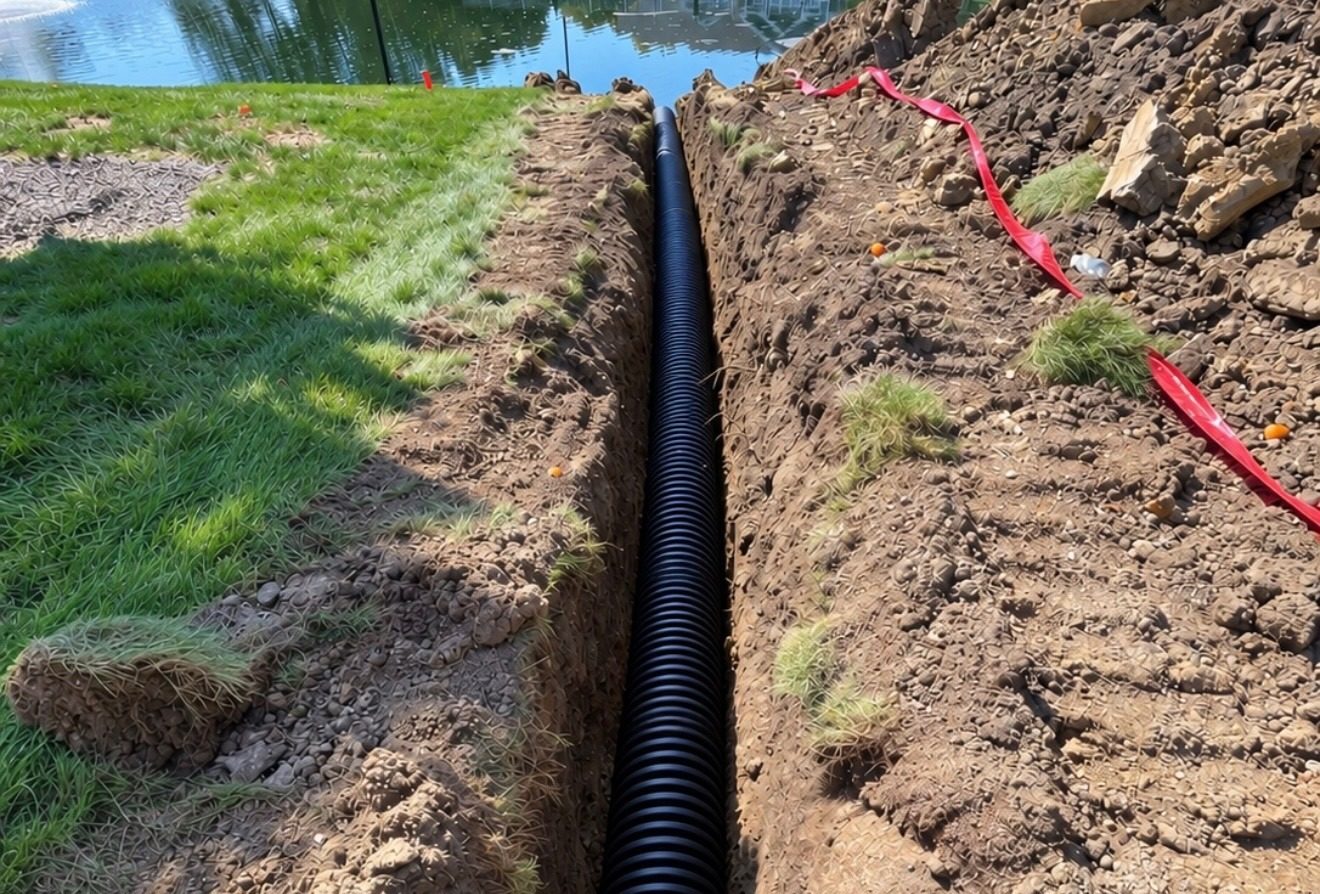
Drainage work moves water off the surface and out of the ground to a lower outlet, using grade, buried pipe and inlets rather than hoping the soil will take it. On heavy glacial till with a lot of clay, which is what Central Indiana sits on, that has to be built rather than assumed.
The ground here is the whole reason this service exists. Glacial till holds water and lets it go slowly, so a rain that would soak away in an hour somewhere sandy will sit on a lawn here for days. Add a flat lot, a compacted building pad, and roof water dumped in one spot by downspouts, and you get the standard Central Indiana complaint: a yard you cannot mow for a week, a low corner that never dries, and water finding the foundation because nothing else is offering it a route.
The tools are not complicated but the sequence matters. Surface water gets caught by grade and by inlets set at the low points. Roof water gets picked up at the downspouts and piped out rather than left to spread. Water that is already in the ground gets intercepted by a perimeter or curtain drain that gives it an easier path than your basement wall. All of it has to reach an outlet that is genuinely lower, because a drain line running to nowhere is just a buried place for water to sit.
We do this for homeowners with a wet yard, for builders who need a lot to drain before it is finished, and for businesses and municipalities dealing with water on a site. Whatever the property, we start by working out where the water is coming from and where it can legally and physically go, because those two answers decide everything else.
How a drainage job runs
Tell the office what you are seeing
Where the water stands, how long it stays, what changed recently, and whether it is reaching a building.
Service area and scope
We check the property is in our area and get a first sense of whether this is grade, pipe, inlets or all of it.
We walk the property
On site we find the high ground, the low ground and the outlet, because the outlet decides what is possible.
Written estimate
You get the layout in writing: the runs, the inlets, the outlet and the grade work, before anything is scheduled.
Scheduling, permits and locates
Permits, the Indiana 811 locate with its two working day notice, and any inspection required are arranged by the office.
Build it, grade it, close it out
The crew installs the system and finishes the ground, keeps you informed, and the job ends with a final inspection and the invoice.
Why water sits in a Central Indiana yard
Three things usually combine. The soil is clay and it will not take water quickly no matter what you do to the surface. The lot is flatter than it looks, so water that should be running has no reason to. And somewhere in the property's history a grade got changed: a patio went in, a pad was built up, a landscaping bed was raised, and a route the water used to take quietly closed. None of those show up as a problem until the rain that finds them.
The part that turns a nuisance into a repair bill is what standing water does next to a building. Water that pools against a foundation is water pressing on it, and it will find the easiest way through: a joint, a wall crack, a window well. Most of the basement water calls we get trace back outside, to a yard that never had a route off it. Fixing the yard is usually cheaper and more permanent than fighting the same water in the basement year after year.

What this does not cover
We work from where the water lands to where it leaves the property. Gutters, downspouts and anything attached to the house above the ground are a gutter or roofing contractor's work, and we pick the water up from the point it comes down. Lawn installation, irrigation systems, planting beds and decorative landscaping are a landscaper's lane. We can bring the disturbed ground back to a finished grade, and what that restoration includes is written into the estimate rather than left to be argued about later.
Drainage Questions
Where does all this water actually go?
To an outlet that is lower than where it starts, which is why the outlet is the first thing we look for on site. That might be a swale, a ditch, a culvert or a storm structure depending on your property and your community. If there is no lower outlet available, the honest answer is a different design, and we would rather tell you that at the estimate than after digging.
Will you put the yard back when you are done?
The disturbed ground gets backfilled and brought back to a finished grade, and exactly what the restoration covers is written into the estimate before the work is scheduled. We would rather have that conversation on site while we are looking at the same ground you are, because how a yard gets left is one of the things people care most about and it should not be a surprise.
Can drainage fix a wet basement?
It fixes a large share of them, because a lot of basement water is really yard water that was never given a route away from the building. Grade, downspout lines and a perimeter drain change what the foundation is standing in. If water is already coming in, drainage outside and a working sump system inside usually get looked at together rather than one at a time.
Do you do drainage on job sites and commercial property?
Yes. Builders, contractors, businesses and municipalities are a regular part of this work, whether that is getting a lot to drain before a build is finished, moving water off a commercial site, or dealing with a low area that has become a problem. The process is the same as it is for a homeowner: the office takes the details, we come look, and the scope goes in writing.
Drainage Work, in Their Words
Left on our Google profile by the people we did the work for.
“Our home is in a lower, recessed area of the neighborhood and has a tennis court surrounded by forested landscape, wildlife and a creek running the perimeter of the property. While not in a flood zone, we do have challenges with heavy rain and creek overflow. We have used Matt’s services since we bought this home in 2013. He has provided services ranging from French drainage systems to Riprap with cement armoring for creek bank stabilization. In addition, he installed high-tech carbon fiber belts to the tennis court creek bulkhead (retaining wall) to support its structure. We are extremely pleased with Wharff Excavating LLC. Matt and his crew are ALWAYS quick, proficient and professional, providing the highest standard of quality grading, erosion and excavation workmanship you can find in the Indianapolis area. We highly recommend Wharff Excavating services.”
“Wharff Excavating did an excellent job fixing a downspout issue that had been causing serious flooding in my yard. Casey and his crew were quick to respond, professional, and clearly experienced. They found the problem right away, rerouted the drainage properly, and made sure everything was working before they left. Since the work was done, I haven’t had a single issue, even after heavy rain. I’m really grateful for their help and recommend them to anyone dealing with drainage problems!”
Request a Drainage Estimate
Tell us where it is and what it is doing. If you have photographs of the problem, send those too.
We look at it on site before we quote it, and the estimate comes to you in writing.