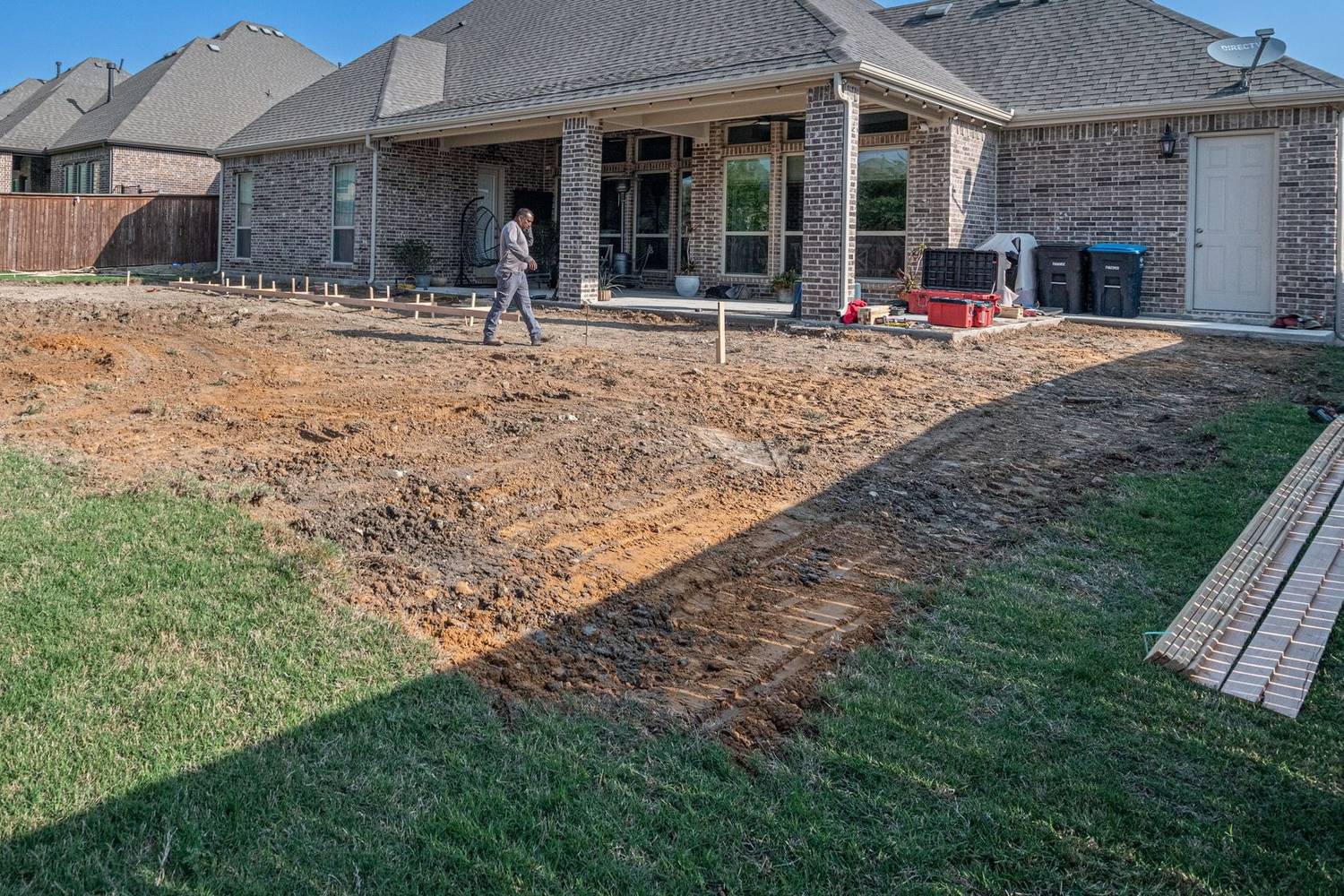
Finish Grading for Yards and Building Sites in Central Indiana
Finish grade is the last shaping of the ground, the pass that quietly decides where water goes for as long as the building stands there.
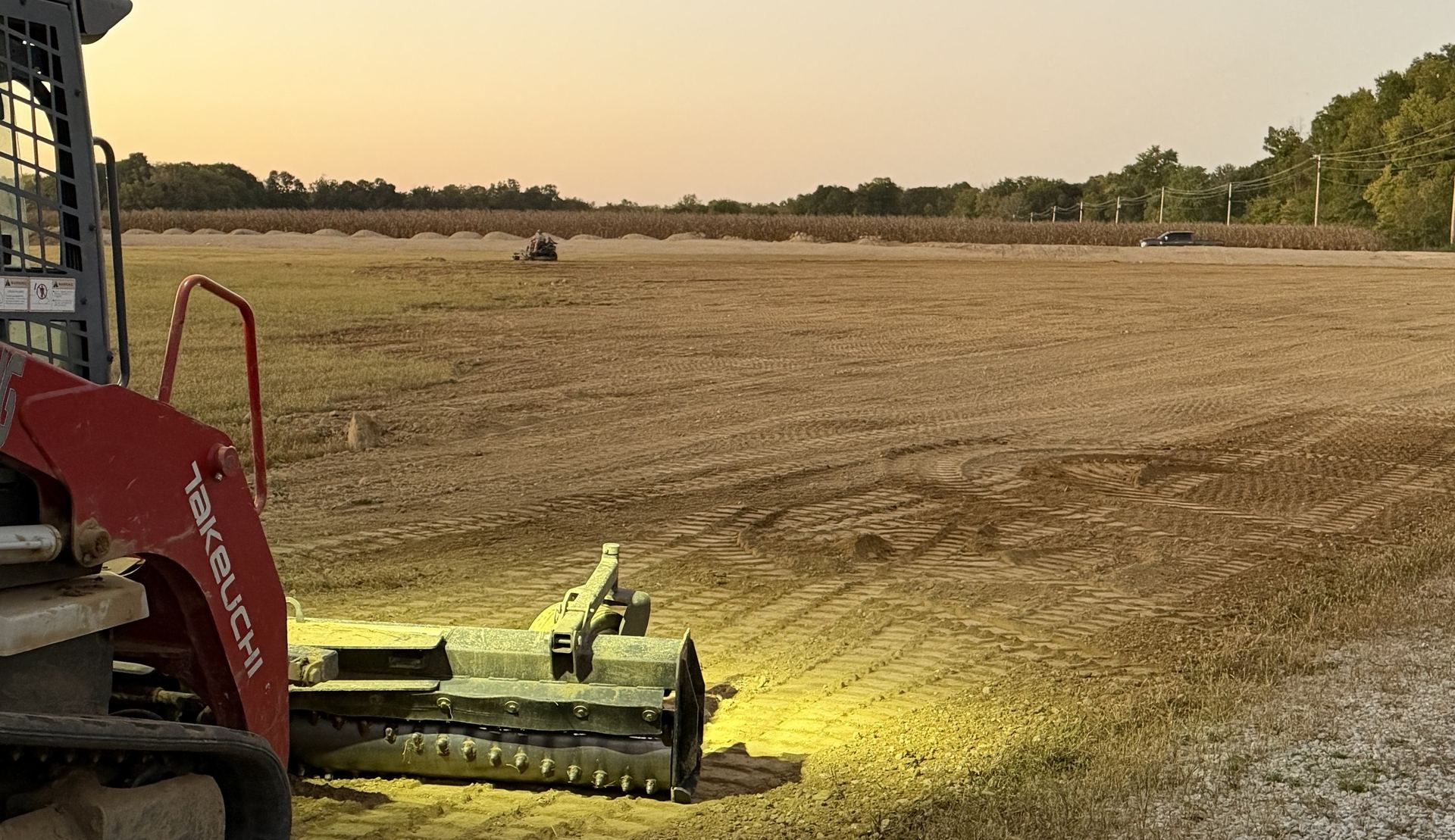
Finish grading is the final shaping of soil once the heavy excavation is finished. It sets the fall away from a foundation, smooths out the ruts equipment left behind, and leaves ground that is ready for seed, sod or paving. On clay soil this pass is the difference between a dry basement and a wet one.
There are two grades on any site and they are not the same job. Rough grade is bulk movement: getting the site close, hauling material where it needs to be, building the pad, opening the hole. Finish grade is the last inch or two, and it is precision work with a very different objective. Rough grade is about volume. Finish grade is about slope, and slope is about water.
The rule that governs the whole thing is simple to say and easy to get wrong: ground next to a house has to fall away from the house, continuously, with nowhere along that run for water to collect and sit. A yard that looks flat to the eye can still be pitched a couple of inches the wrong way, and a couple of inches the wrong way is enough to walk water down a foundation wall every time it rains. That water is what ends up as a damp basement, a wet crawl space, or, over enough years, pressure against a wall that starts to move it.
Most of our finish grade work comes after somebody else's heavy equipment has left. New construction where the lot is a rutted mess and the owner wants a yard. An addition or a basement job where the backfill has settled and left a low ring around the house. A property where the original grade got buried under years of mulch beds and added soil until the ground outside is higher than it should be. We shape what is there, bring in soil where the ground has settled below where it needs to sit, and leave a surface that drains and that somebody can seed or sod without fighting it.
The order of a finish grade job
The office takes it down
Tell the office what the ground is doing and what you want it ready for, and that goes on the job before anybody drives out.
Scope and area
We check the property is in the area we cover and work out how much ground is involved and whether soil has to come in or go out.
Walking the ground
We come out and read the site in person, because fall of an inch or two across a yard is not something you can judge from a description.
The written estimate
A detailed written estimate goes to you covering the area to be graded, the soil involved and the finished condition we are leaving it in.
On the schedule
The work gets scheduled, and we take care of any permits, utility locates and inspections the job calls for.
Graded, then closed out
The crew works the ground and keeps you informed as it goes, and the job ends with a final inspection and the invoice.
What a bad grade does to a house
Water that cannot get away from a foundation does not simply evaporate. It soaks into the ground right against the wall, and in clay soil it stays there, because clay does not let it move sideways or down at any useful speed. Saturated clay against a basement wall pushes on it. That push is constant, it gets worse every time it rains, and it is the reason so many basement walls in this part of the state develop a horizontal crack partway up.
The damage on the surface is easier to see. Grass that will not grow in the same strip every year. A low spot that stays soft for days after a storm and gets tracked into the house. Mulch floating out of a bed and across a walk. A window well that fills. Every one of those is the same story told a different way, which is that the ground is holding water where the ground should have been sending it somewhere else, and the fix is grade rather than anything you can pour or plant.

Where finish grade stops
We shape and prepare the ground. We are not a landscaping company, so seeding, sod, irrigation, plantings and bed work are somebody else's trade and we hand off a surface that is ready for them. Where the fix is genuinely below the surface, meaning the yard needs pipe, a swale with an outlet, or a sump discharge routed somewhere sensible, that is drainage work rather than grading, and we will scope it as such instead of pretending shaping alone will carry it.
Finish Grade Questions
What is the difference between rough grade and finish grade?
Rough grade is bulk earthwork: opening the hole, building the pad, moving material in quantity to get the site near its final elevations. Finish grade is the last pass, working the top few inches to a specific slope so water runs where it should and the surface is smooth enough to seed or sod. One is about volume and one is about accuracy.
Can grading fix water standing against my foundation?
Frequently it can, and it is usually the first thing to look at, because water pooling next to a wall is often just ground that falls the wrong way. What grading cannot do on its own is move water that has nowhere to go once it leaves the house. If the low point is in the middle of the yard with no outlet, the job needs drainage as well as shaping.
Do you grade for builders before sod goes down?
Yes. Builders and contractors call us for exactly that, once the heavy work is done and the site needs to be turned from a construction surface into a yard. We take out the equipment ruts, set the fall away from the house and any hard surfaces, and leave a finished surface ready for whoever is putting the lawn in.
What if the yard is short of soil?
Ground that has settled below where it needs to sit has to be brought back up before it can be shaped, and that means soil coming in. Tell the office what you are seeing, we will look at it when we come out, and whatever material the job needs is written into the estimate rather than turning up as a surprise later.
Finish Grade Work, in Their Words
Left on our Google profile by the people we did the work for.
“Wharff Excavating provided excellent work on a drainage and grading project at our home. The crew was very efficient and professional in all aspects of their work. We are extremely pleased with their top tier work.”
Request a Finish Grade Estimate
Tell us where it is and what it is doing. If you have photographs of the problem, send those too.
We look at it on site before we quote it, and the estimate comes to you in writing.