Directional Boring in Indianapolis and Central Indiana
Boring puts a new line under a driveway, a road or a finished lawn without opening a trench across the surface you would otherwise have to rebuild.
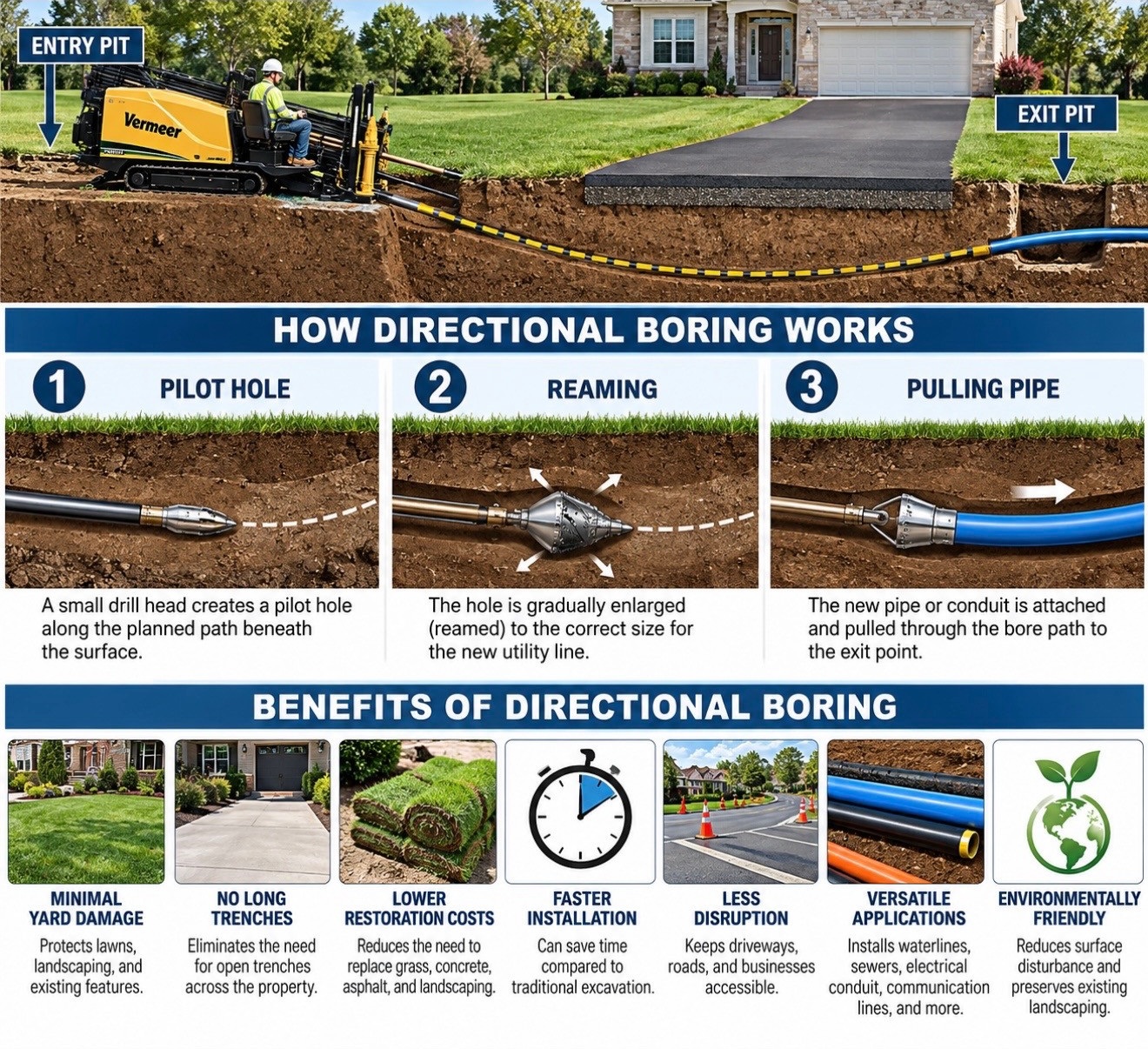
Directional boring installs a buried line between an entry pit and an exit pit without an open trench across the surface between them. A small drill head creates a pilot hole along the planned path, the hole is reamed to the size the new line needs, and the new pipe or conduit is pulled through the bore path. That is why it is used to cross a driveway, a road or a lawn you want left intact.
The mechanics are worth understanding, because they explain what the method is good at. The work runs from an entry pit to an exit pit in three steps. First a small drill head creates a pilot hole along the planned path beneath the surface. Then the hole is gradually enlarged, or reamed, to the correct size for the new utility line. Finally the new pipe or conduit is attached and pulled through the bore path to the exit point.
That changes the arithmetic on a lot of jobs. Trenching across a concrete drive means cutting it, removing it, digging, backfilling and then paying to replace the drive. Trenching across a county road usually means a closure and a restoration nobody wants to own. Trenching across an established lawn means a scar that takes a season to stop showing. A bore crosses all three without an open trench across them.
We use it for water service lines, for conduit carrying electric or communication cable, and for runs that have to get under a drive, a walk, a road, a landscaped area or a stand of mature trees whose roots you do not want cut. It gets used on new construction, on replacement work where the property is already finished, and on jobs for builders, businesses and municipalities where the surface above simply is not available to open.
How a bore is planned and run
The office takes the details
What is being installed, roughly how far it has to travel, and what it has to get under.
Scope and service area
We confirm the property is in our area and work out the length, the product line and the entry and exit points.
We read the site in person
On site we set where the pits go, what the path has to clear, and whether the ground and the depth suit a bore at all.
Written estimate
The estimate names the bore path, the pits, the line being pulled and the surface restoration at each end.
Locates first, then scheduling
The Indiana 811 locate is required statewide with two working days of notice, and on a bore it is not a formality, it is the map. Permits and inspections are arranged with it.
Bore, pull back and close out
The crew drills the path, pulls the line through, restores the pits, keeps you informed, and the job closes with a final inspection and the invoice.
What boring saves you
The cost of a utility crossing is rarely the pipe. It is everything you have to put back. A driveway that gets cut has to be replaced, and the patch never quite matches. A road crossing brings traffic control and a restoration specified by whoever owns the road. A finished lawn with irrigation and mature trees in it can lose more value to a trench than the utility work itself is worth. Boring reduces that expense because there is no open trench across the surface to restore.
It also removes a scheduling problem. An open trench across a drive means the drive is out of service, and on a commercial property or a municipal site that can matter more than the money. A bore keeps the surface in use while the work happens underneath it. There are places where a trench is still the better call, and we will say so, but where a crossing is the hard part of the job, boring is usually the answer that leaves the least behind.
What boring is not right for
Boring is not the answer everywhere and we would rather say that up front. A gravity line such as a sewer run has to hold a consistent fall, so a bore only suits it where the path can be held to that slope. Very shallow crossings, ground full of unknown obstructions, rock and congested areas thick with existing utilities can all make a bore the wrong tool, and an open cut is safer and cleaner. We read that on site and tell you which method your ground actually supports before you commit to either.
Directional Boring Questions
Can you really get a line under my driveway without breaking it up?
Usually, yes. That is what the method is for. The bore runs under the drive between an entry pit and an exit pit, so the drive itself is not trenched. The same applies to sidewalks, patios, roads and landscaped areas where an open cut would cost more to repair than the utility work costs to install.
Do you still have to dig anything at all?
Yes, a pit at each end. The rig needs a place to enter the ground and the line needs a place to come out and be connected. Those pits are small compared to a trench that runs the whole distance, and they sit where you choose them rather than wherever the route happens to cross something valuable. Restoring them is part of the written scope.
How do you know what is already buried along the path?
Indiana requires a call to 811 before digging anywhere in the state, with two working days of notice, and the locate that follows marks the utilities other companies own. On a bore that information is not paperwork, it is the plan, because the head is traveling underground for the whole run. The head is tracked from the surface as it goes so its position is known rather than assumed.
Is boring only for new construction?
No. A lot of it is replacement work on property that is already finished, which is exactly where it earns its keep. A failed water service under a paved drive, a conduit that has to reach a detached building, a line that has to cross a road: all of those are easier to bore than to trench once the surface above is something you would have to rebuild.
Do you bore for contractors and municipalities?
Yes. Builders, general contractors, businesses and municipalities all bring us crossings where the surface cannot be opened, alongside homeowners. The process does not change with the customer: the office takes the details, we look at the path on site, and the scope is written down before it is scheduled.
Directional Boring Work, in Their Words
Left on our Google profile by the people we did the work for.
“Wharff Excavating did a great job boring our new water line. The owner is very knowledgeable and took the time to answer all of our questions! The crew was friendly, professional, and did excellent work. I would definitely recommend them to anyone needing excavation or water line services!!”
Request a Directional Boring Estimate
Tell us where it is and what it is doing. If you have photographs of the problem, send those too.
We look at it on site before we quote it, and the estimate comes to you in writing.